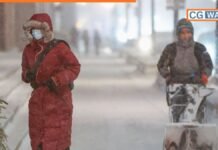
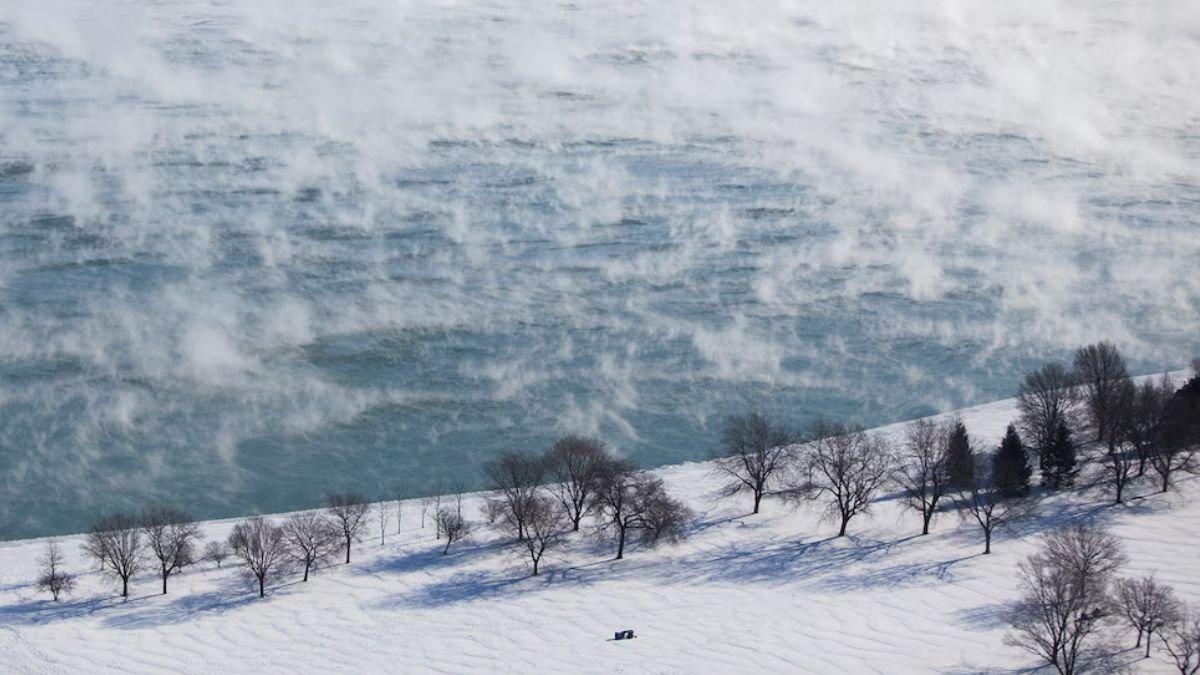
A powerful polar vortex is poised to plunge millions of Americans and Canadians into dangerously cold weather beginning mid-December 2025, with forecasters warning of the coldest air of the season so far. The National Weather Service and Environment Canada issued updated outlooks today, December 7, confirming that a major disruption of the polar vortex will send Arctic air surging southward, affecting regions from the Upper Midwest and Great Lakes to the Northeast, Mid-Atlantic, and parts of the Southeast.
The cold wave is expected to arrive in two phases. The first blast begins Tuesday, December 10, dropping temperatures 15 to 25 degrees below average across the Plains and Midwest. Chicago, Minneapolis, and Detroit could see daytime highs struggle to reach 10°F by Wednesday, with overnight lows dipping to -10°F or colder. Wind chills may fall to -30°F in northern areas, prompting Wind Chill Warnings.
A second, stronger surge arrives December 14–16 as the vortex fully displaces southward. Cities along the Interstate 95 corridor—including New York, Philadelphia, Washington D.C., and Boston—face highs in the teens and lows near 0°F, marking the coldest weather since January 2024. Even southern cities such as Atlanta, Charlotte, and Nashville will shiver through highs in the 30s and lows in the low 20s, well below early-December norms.
Canadian cities will feel the brunt earliest and hardest. Winnipeg, Regina, and Ottawa are forecast to see highs below -15°F (-26°C) by December 11, with Calgary and Edmonton potentially recording lows near -35°F (-37°C) with wind chill.
Meteorologists attribute the outbreak to a sudden stratospheric warming event that began in late November, weakening the polar vortex and allowing frigid air normally locked over the Arctic to spill south. Similar disruptions produced the record-breaking cold waves of February 2021 and January 2019.
Health and safety officials are urging preparation. The Centers for Disease Control and Prevention recommends limiting outdoor time, dressing in layers, and checking on vulnerable neighbors. Utilities across the Midwest and Northeast report increased natural-gas demand and are monitoring power grids for potential strain. Schools in Minnesota, Wisconsin, and Michigan have already placed early-dismissal plans on standby for next week.
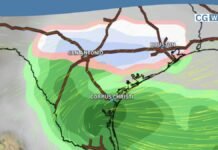
Travel disruptions are likely. Major airports including Chicago O’Hare, Detroit Metro, and Toronto Pearson expect flight delays and cancellations Tuesday through Thursday due to de-icing operations and low visibility from lake-effect snow. Up to 18 inches of snow could fall downwind of the Great Lakes, with Buffalo and Grand Rapids under Lake-Effect Snow Warnings.
Farmers and ranchers in the central U.S. are rushing to protect livestock and winter crops, while cities from Cleveland to Baltimore prepare salt trucks and homeless shelters for extended hours.
Current relevance is surging: Google Trends data shows searches for polar vortex hitting the highest level since January 2024, with breakout increases for terms like polar vortex 2025, extreme cold warning, and how to stay warm in -20°F. The phrase topped U.S. trending searches this morning in Illinois, Michigan, Wisconsin, New York, and Pennsylvania.
The cold snap is expected to ease by December 20 as the vortex retreats northward, paving the way for a milder Christmas week in most areas. However, forecasters caution that additional Arctic outbreaks remain possible through January, keeping winter-weary residents on alert.
Residents are advised to stock emergency kits, insulate pipes, and download local weather-alert apps. Real-time updates are available from the National Weather Service at weather.gov and Environment Canada at weather.gc.ca.
As the first major winter storm of the season approaches, communities across North America are bracing for a memorable dose of Arctic reality.